
Your Browser is not Supported
To use aviary, please update your browser to the latest version
Download Supported Browser
or
I understand the consequences
Go to Homepage
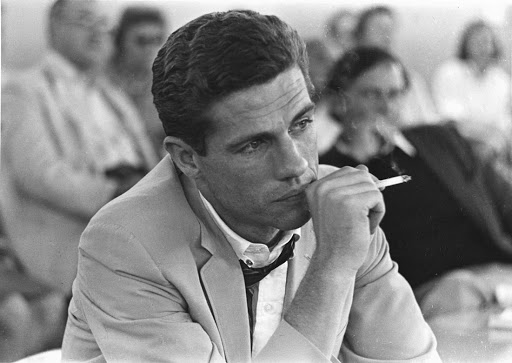
James Blue was born in 1930 in Tulsa, Oklahoma, and moved with his family to Portland, Oregon, in 1942. He graduated from Jefferson High School in Portland, where he participated in the Latin Club. As a teenager, he began experimenting with filmmaking with an 8mm film camera. While a student at the University of Oregon, he was active in theater and radio productions. In 1952, he produced a popular 8mm film parody of Shakespeare's Hamlet with college friends. He earned a B.A. in Speech and Theater from the University of Oregon in 1953. He served in the Armed Forces for two years, then returned to the University of Oregon to pursue a M.A. in Theater Arts in 1955. From 1956 to 1958, he studied cinematography at the prestigious Institut des hautes études cinématographiques (IHDEC) in Paris, thanks to a scholarship from the French government. At IHDEC, Blue took classes from Jean Mitry and Georges Sadoul, and alongside fellow students Costa-Gavras, Johan van der Keuken, and James Dormeyer.
Blue returned to New York in 1958 where he worked for an advertising agency producing television commercials. Two years later he left for Algeria to work with Studios Africa to produce short educational and documentary films for the Muslim population. Blue directed his only feature-length narrative fiction film Les Oliviers de la Justice (The Olive Trees of Justice) between December 1960 and September 1961 during the Algerian Revolution. Les Oliviers de la Justice won the Critics' Prize at the Cannes Film Festival in 1962 and widespread recognition, including showings at the New York and London Film Festivals.
Blue's success with Les Oliviers de la Justice attracted the attention of George Stevens, Jr., director of the motion picture service for the United States Information Agency (USIA). Blue directed several documentary films for the USIA: The School at Rincon Santo (1962), Letter from Colombia (1962), Evil Wind Out (1962), The March (1964), and A Few Notes on Our Food Problem (1968). His films for the USIA won major awards at international film festivals, including a Silver Lion at the Venice Film Festival, and top prizes in both the Bilbao and Amsterdam Documentary Film Festivals. A Few Notes on Our Food Problem received an Academy Award nomination in 1969, and The March was selected to the U.S. National Film Registry in 2008.
In 1964, James Blue received a Ford Foundation grant to interview renowned international film directors, including Jean-Luc Godard, Roberto Rossellini, Vittorio De Sica, Shirley Clarke, and Satyajit Ray. The interviews were intended as research material for a book Blue planned to write on the use of nonprofessional actors in film.
While a filmmaker in residence at the Media Center at Rice University, Blue collaborated with David MacDougall to produce a feature-length film study of an African tribe for the National Science Foundation, Kenya Boran (1974). From 1976 to 1979, Blue produced Who Killed Fourth Ward and Invisible City, multi-part documentaries that examined Houston's housing crisis, poverty, and racism. In Houston, Blue also helped create the Southwest Alternative Media Project (SWAMP), one of several U.S. regional media centers established in the early 1970s.
Blue taught filmmaking at the American Film Institute, UCLA Film School, Fordham University, Rice University, and SUNY Buffalo. He also lectured at Yale University, the British Film Institute, and the Museum of Modern Art in New York City.
James Blue passed away on June 14, 1980 in Buffalo, New York.

To use aviary, please update your browser to the latest version
I understand the consequences
Go to Homepage